Your DOM shows one book. The move often starts in another. NEXUS SYNAPSE reads the order books of ES, NQ, YM and RTY at the same time — in numbers, in heatmaps and in 3D — measures who leads, who lags and who diverges, tests every relation out of sample, and turns it all into one line — that you trade yourself, or let SYNAPSE execute:
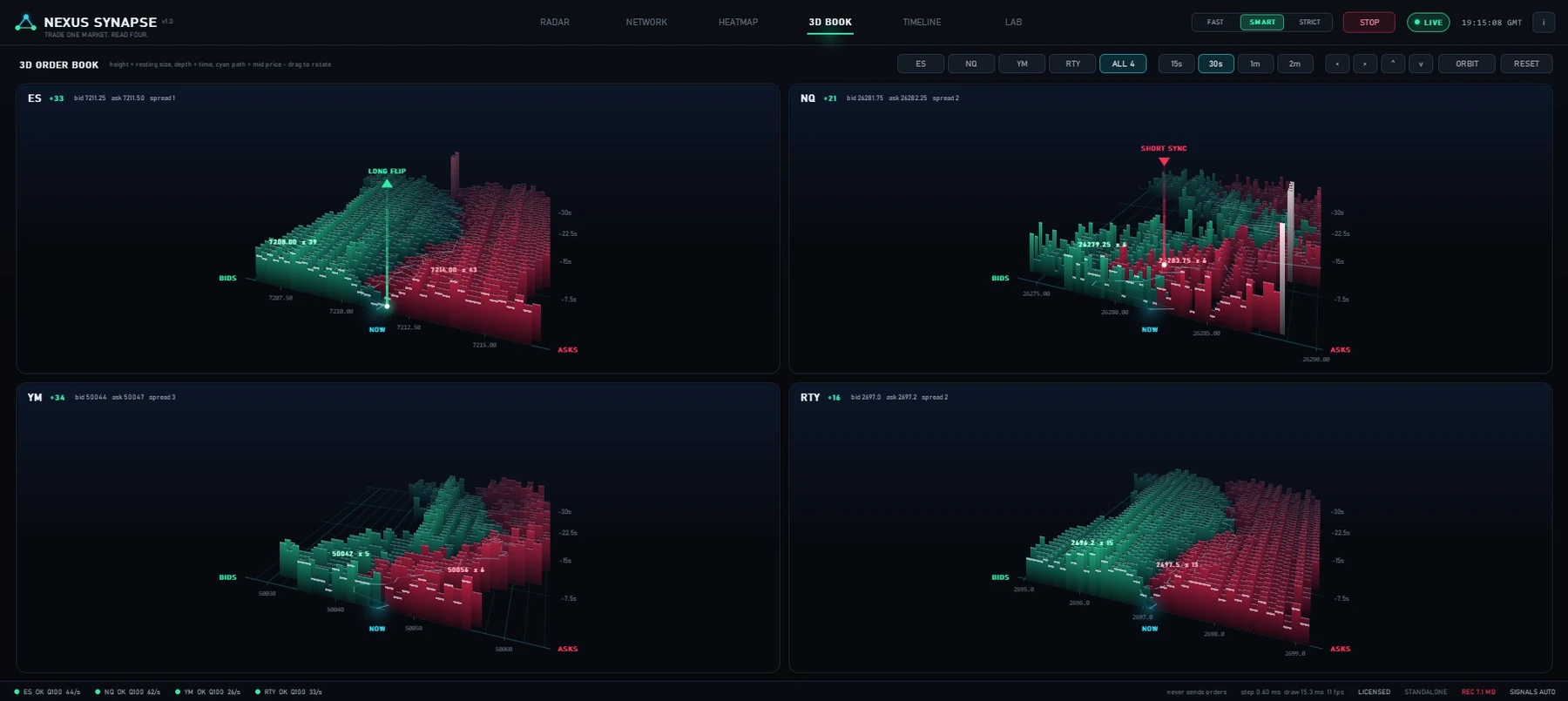
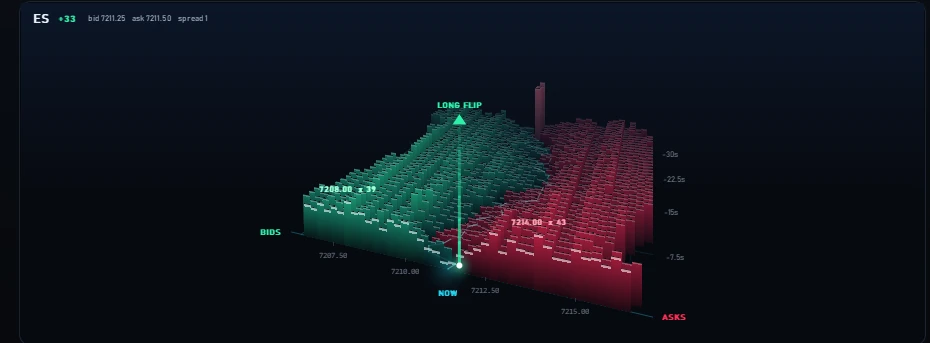
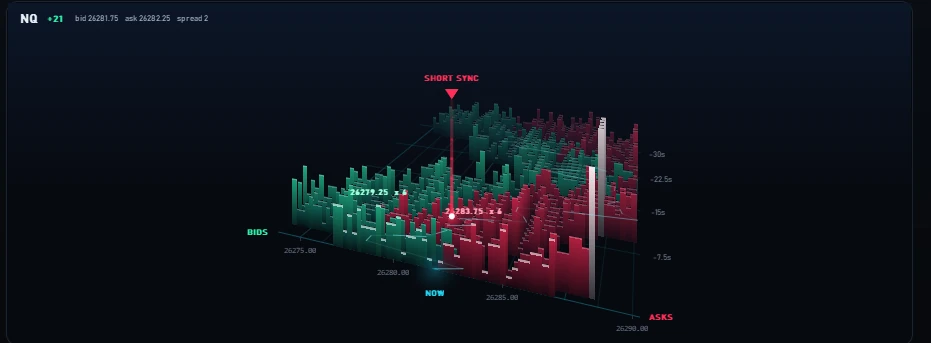
3D ORDER BOOK, live on the CME feed (24 Nov 2026, 19:15 GMT): the four index books as liquidity landscapes — bids green, asks red, height = resting size, 30 seconds deep. A LONG FLIP fires on ES, a SHORT SYNC on NQ.
Live, SYNAPSE now reads every executed trade of ES, NQ, YM and RTY with the side of the aggressor — and the Edge Lab shows, on your own feed, what a trade really costs, which exit works and which setups to leave alone.
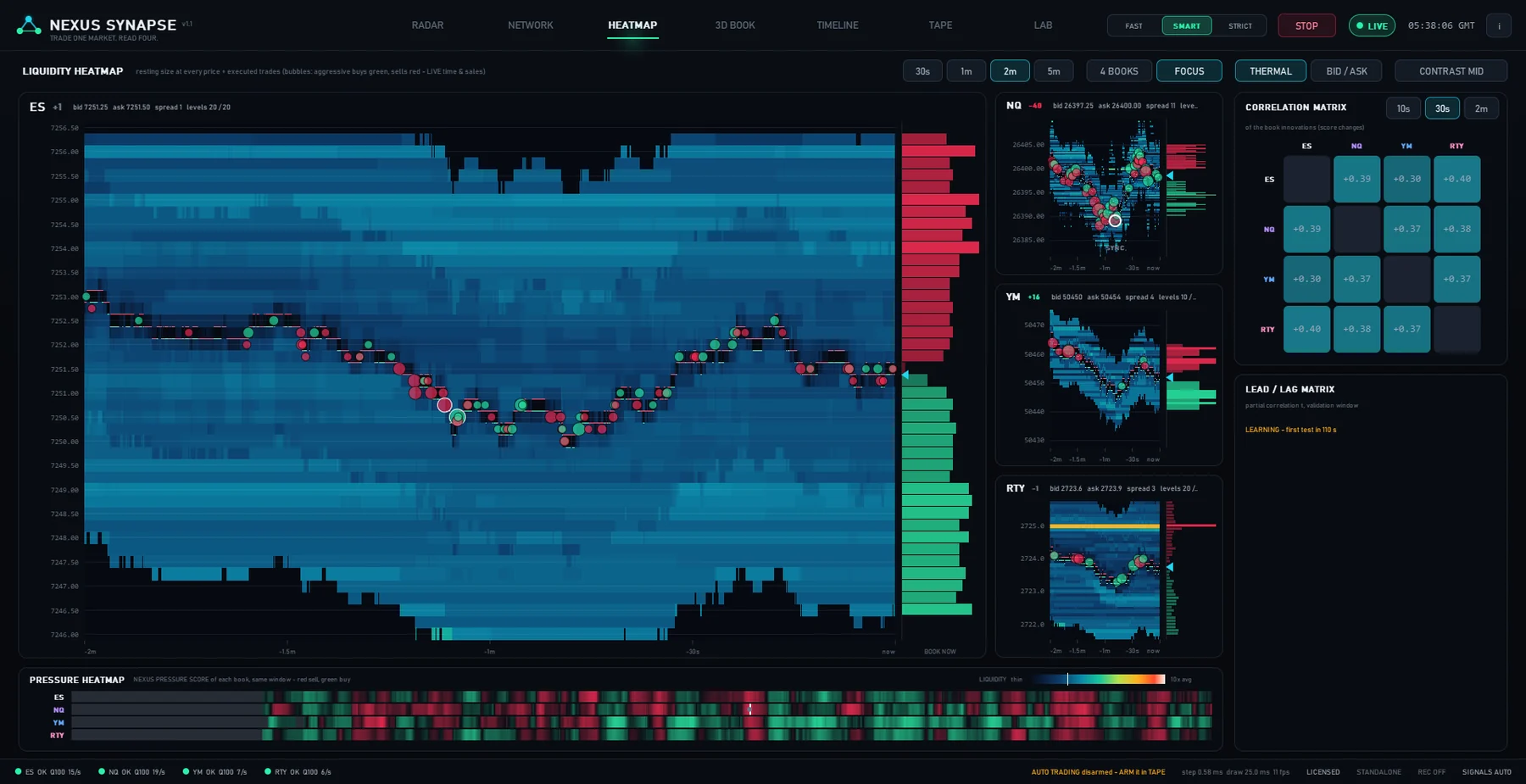
HEATMAP, live (26 Nov 2026): FOCUS on ES, 2 minutes — resting orders in colour, every executed trade as a bubble (aggressive buys green, sells red, size = volume).
Bubbles on the HEATMAP, spheres in the 3D BOOK, the aggressive delta in the TIMELINE, the NETWORK and the TAPE. A wall that vanishes without trades was pulled, not eaten.
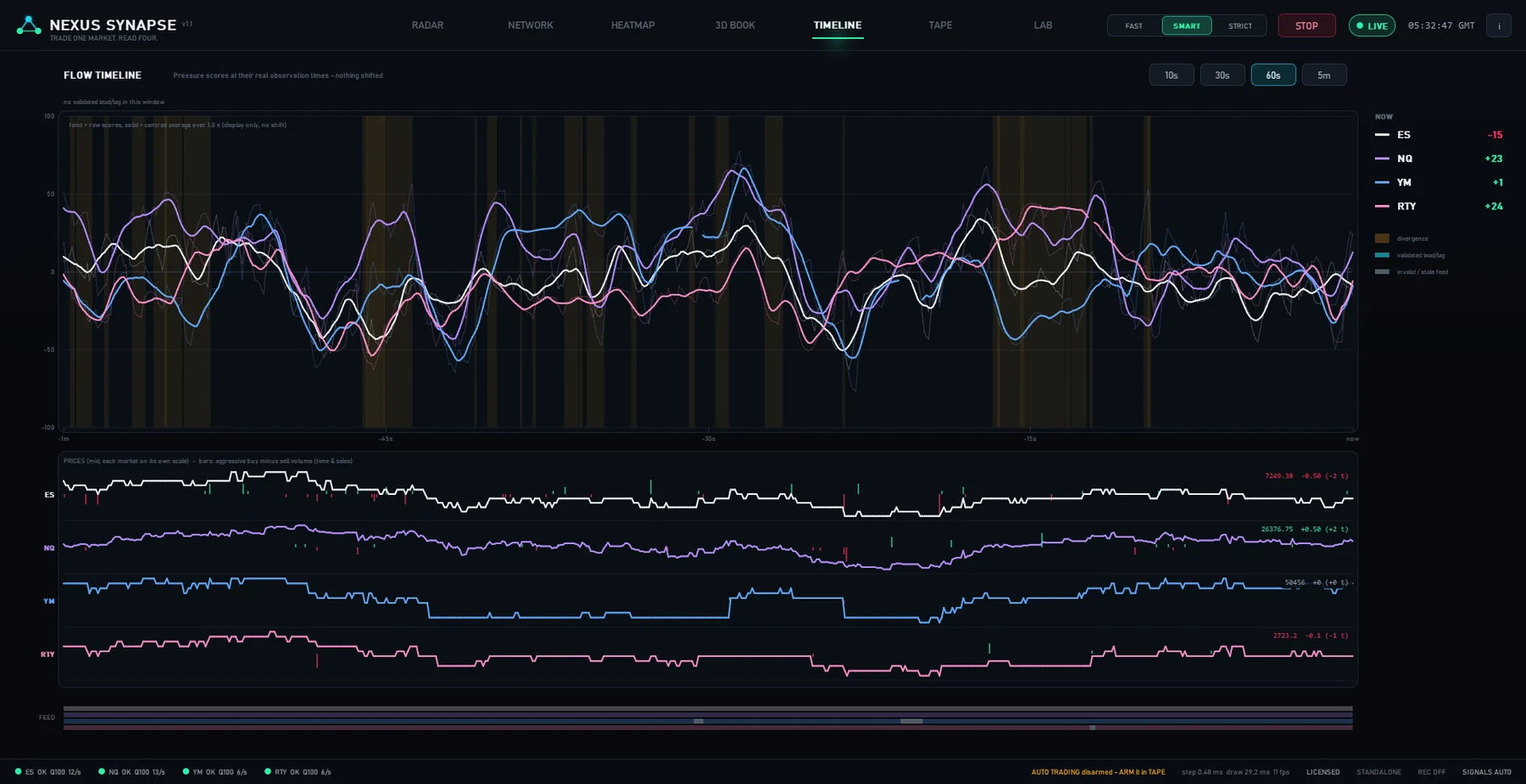
The four prices under the four pressure scores, on the same clock, with the real buying and selling below each one. See whether the move followed the books.
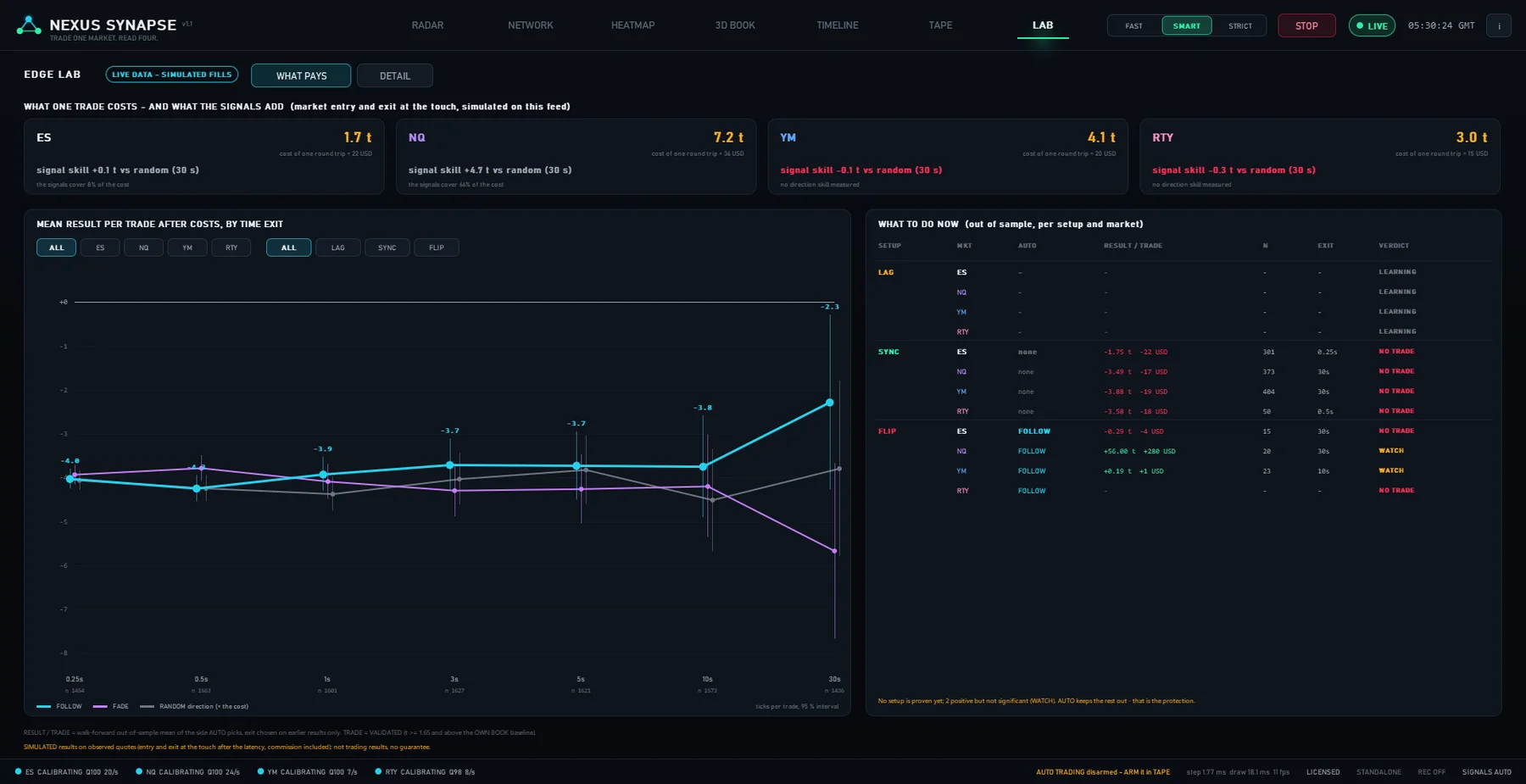
The cost of a round trip per market, the result of every exit from 0.25 s to 30 s, and what to do per setup — out of sample. AUTO TRADING can use the exit the Lab selects.

TIMELINE, live: the four pressure scores, and below, the four prices with the aggressive delta.

EDGE LAB > WHAT PAYS on 40 hours of the owner's own data (simulated): costs, exits, verdicts.
ES, NQ, YM and RTY are the same story told by four different crowds. When the buyers step in on the Nasdaq and the Russell, the S&P book does not always follow at the same instant. When the bids build everywhere at once, it is rarely random.
No human can watch four depth ladders, compare them and judge in real time whether a relation is real or just noise. NEXUS SYNAPSE does exactly that, ten times per second — and shows it to you.
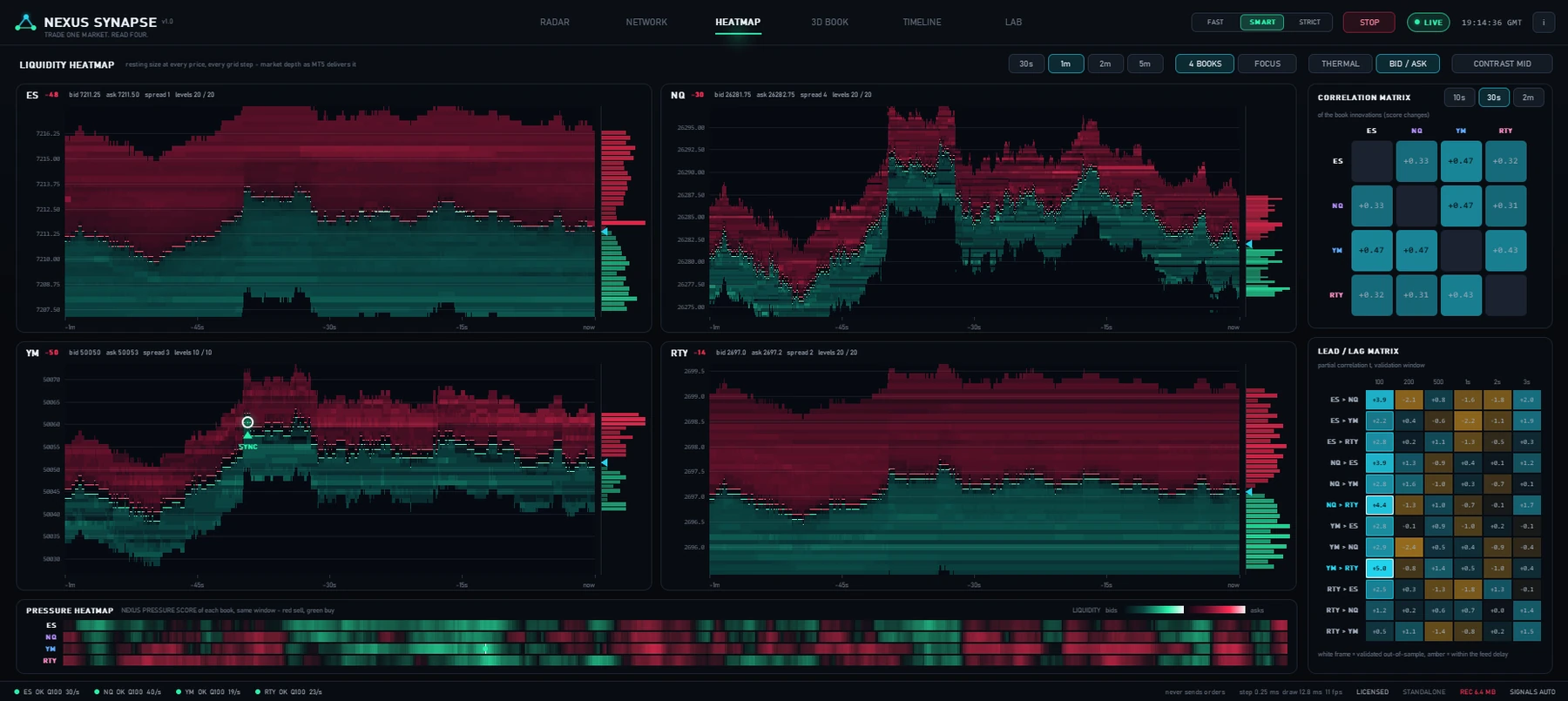
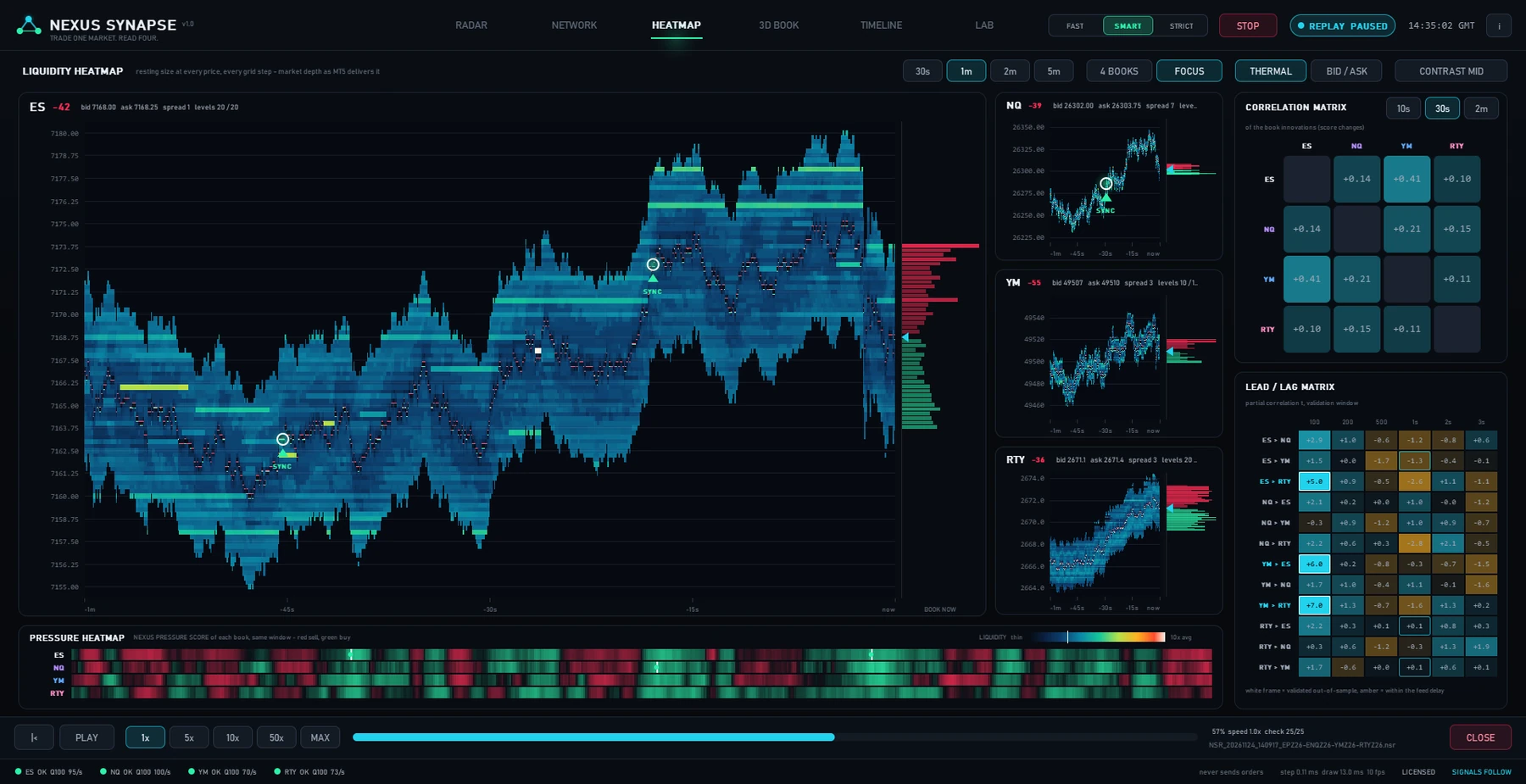
Every resting order, at every price, ten times per second — for ES, NQ, YM and RTY side by side. Walls light up, holes go dark, the best bid and ask draw the path of the price through them — and, live, every executed trade lands on it as a bubble.
HEATMAP, live (24 Nov 2026, 19:14 GMT), BID / ASK colours: one minute of the four books, bids in green, asks in red; the pressure heatmap below; the correlation and lead/lag matrices on the right.
Resting size at every price and every 100 ms, from 30 seconds to 5 minutes. THERMAL or BID / ASK colours, adjustable contrast, the book as it stands now beside each map, price / age / size under your mouse.
The NEXUS PRESSURE SCORE of each market as a colour band on the same clock. Synchronised waves jump out — so does the market that stays behind.
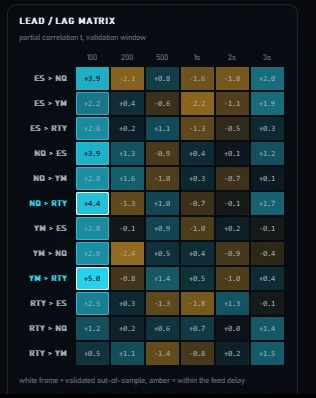
Correlation of the four books (10 s / 30 s / 2 min) and a lead/lag matrix: every pair, every delay from 100 ms to 3 s. Validated relations are framed. Nothing is assumed.

FOCUS on ES, THERMAL colours, at the US cash open of 24 Nov 2026 (replay of a real recording): the bright horizontal lines are large resting orders.

LEAD / LAG MATRIX, live: every pair of books, every delay from 100 ms to 3 s. The framed cells passed the out-of-sample test.
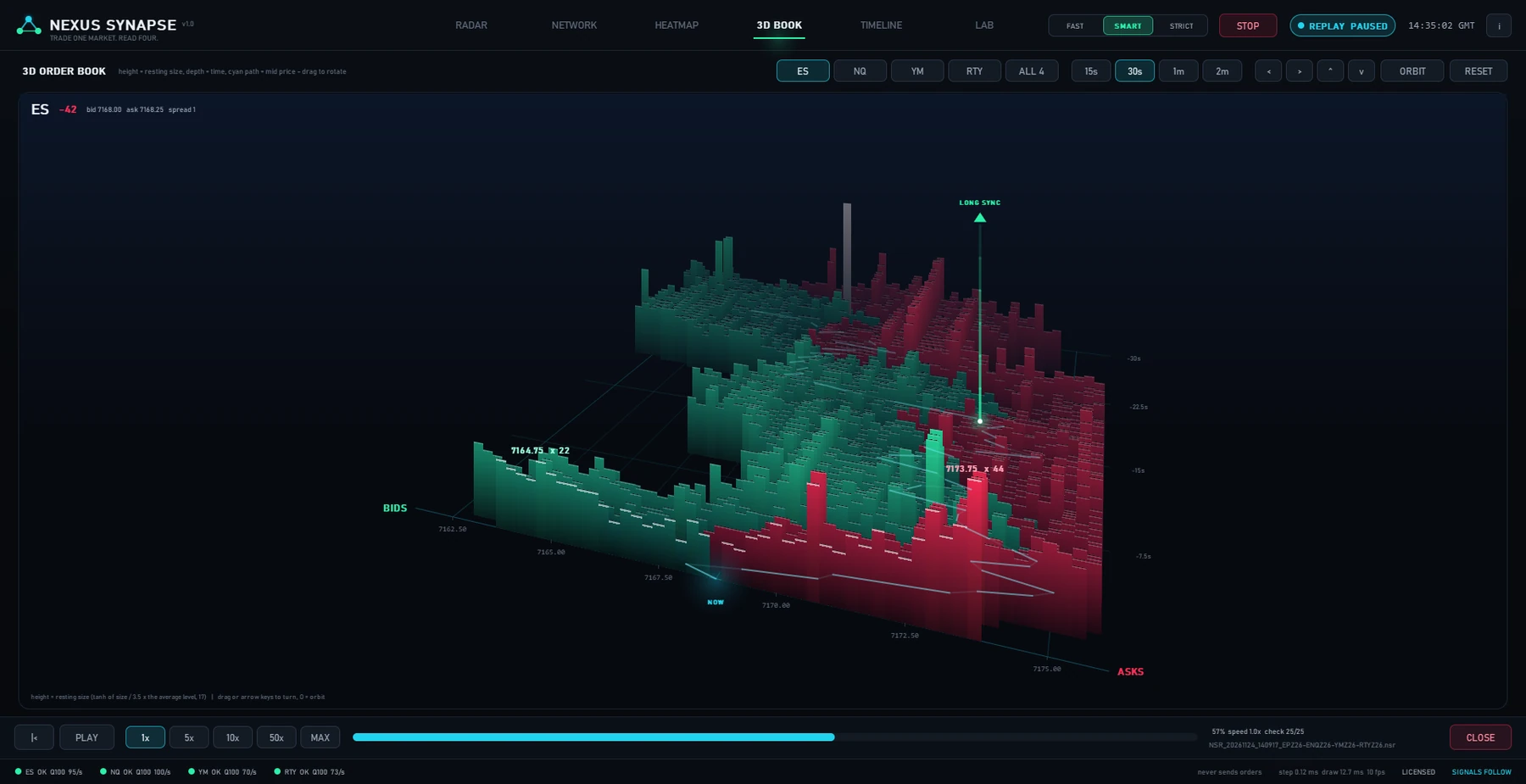
Price from left to right, time from back to front, resting size as height. Walls stand up, holes become valleys, and the cyan line traces the price through them. Light beams mark every signal where and when it fired; live, the executed trades float along the price as spheres.
ES at 14:35 GMT on 24 Nov 2026 (replay of a real recording): 30 seconds of the book in 3D. The biggest bid and ask of the moment are labelled.

ES, live: a LONG FLIP beam at the price and time it fired.

NQ, same instant: a SHORT SYNC. The white column is a large resting order.
All the complexity stays inside the engine. You get the answer — and, when you want it, the full picture.

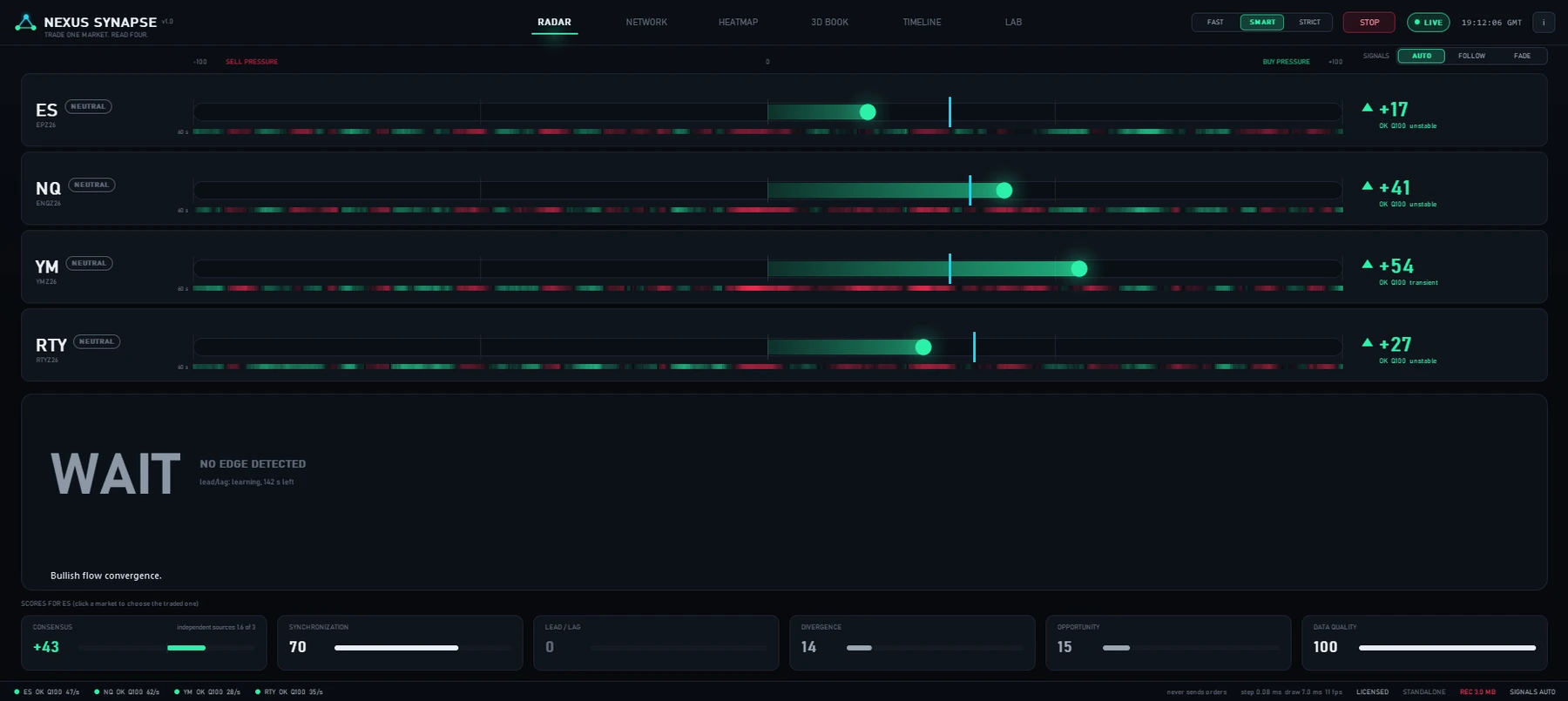
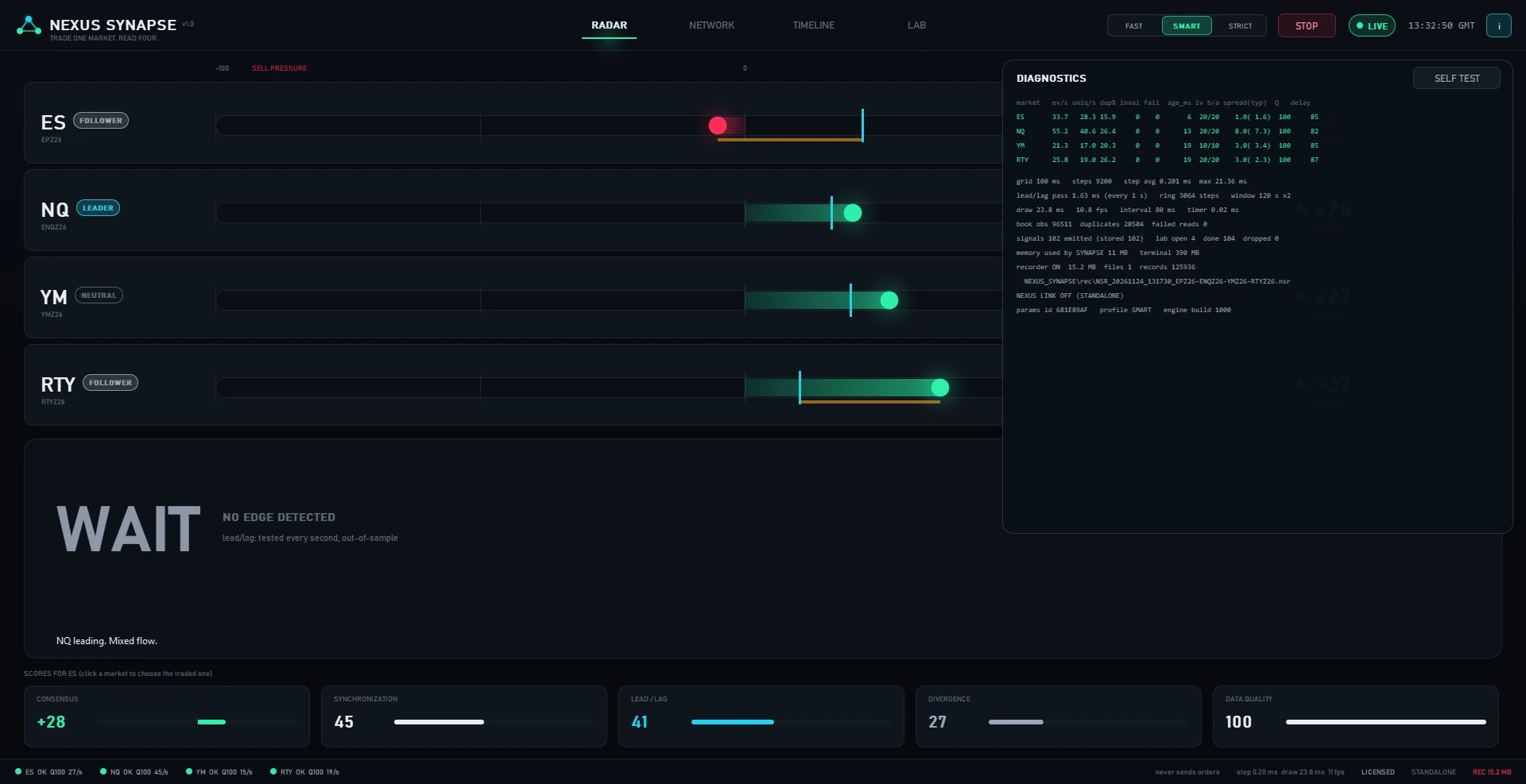
RADAR, live (24 Nov 2026, 19:12 GMT).
Some traders go with the pressure. Others take the other side of a move that has already happened. SYNAPSE lets you choose — and measures both.
Every signal is simulated in both directions, each with its own fills (the spread is paid both ways). In AUTO, the Edge Lab picks — for each setup and each market — the side that did better out of sample on your own feed. And when neither side pays after costs, it says so: NO TRADE.
The EXTENDED badge warns you when the price had already run before the signal.
Buying pressure across the books → LONG. The classic reading.
Every signal inverted, with a FADE badge. For the trader who sells the stretch.
Follows while it learns, then picks FOLLOW or FADE per setup and market from out-of-sample results — or NO TRADE.
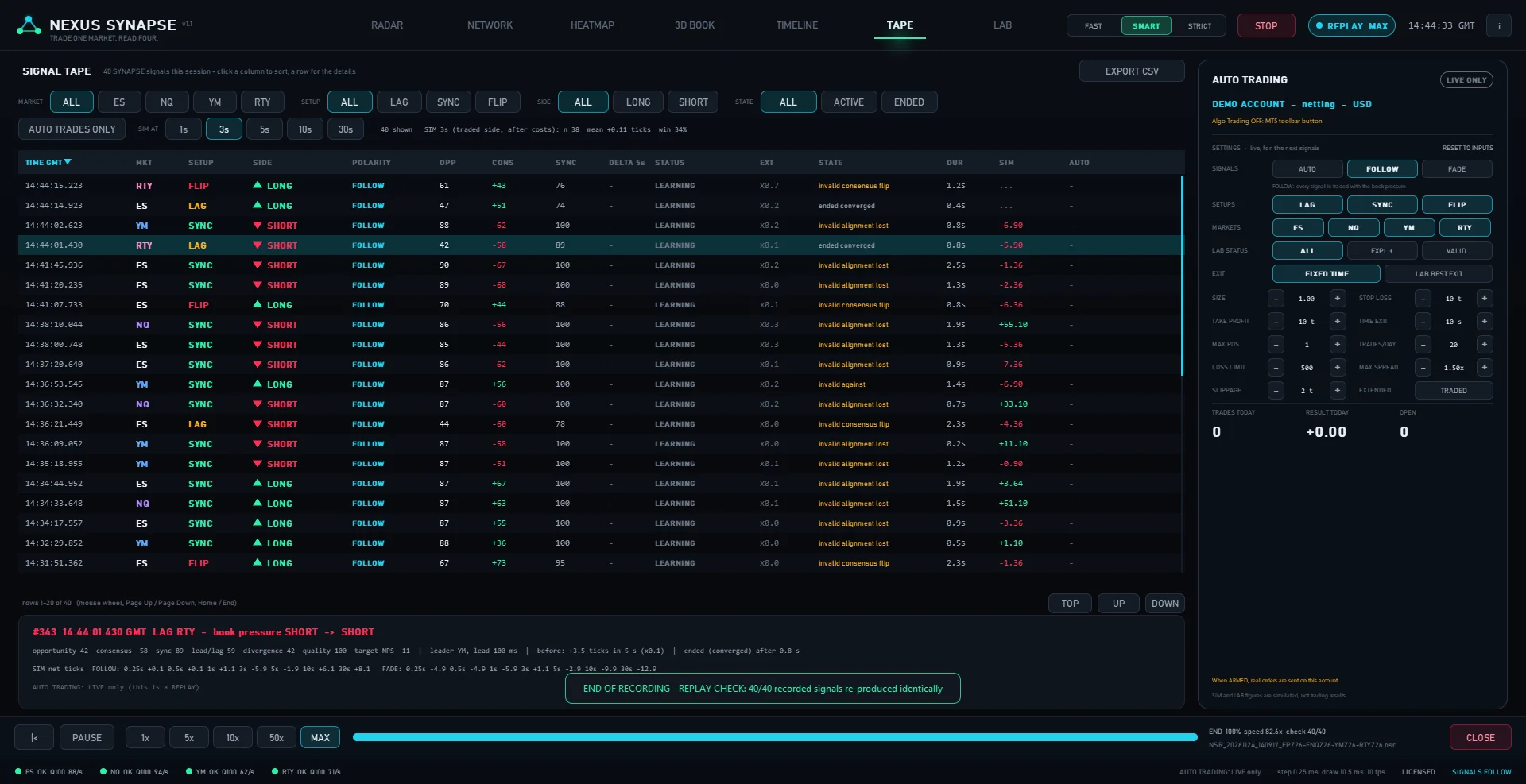
Every LAG, SYNC and FLIP of the session in one tape: when, where, which way, how strong, how it ended — and what it would have made after costs, on both sides. Sort by any column, filter in one click, export to CSV.
TAPE at the US cash open of 24 Nov 2026 (replay of a real recording): 40 signals, newest first, one selected with its full story at the bottom; the AUTO TRADING panel on the right.
Sort by time, opportunity, consensus, sync, status, duration, simulated result or trade result. Filter by market, setup, side, state — or show the auto trades only.
Who led and by how many milliseconds, how many books aligned, how far the price had run before, the result at every horizon from 0.25 s to 30 s — followed and faded.
EXPORT CSV writes the whole tape, trade results included, for Excel or Python. The scalper's logbook, filled in for you.
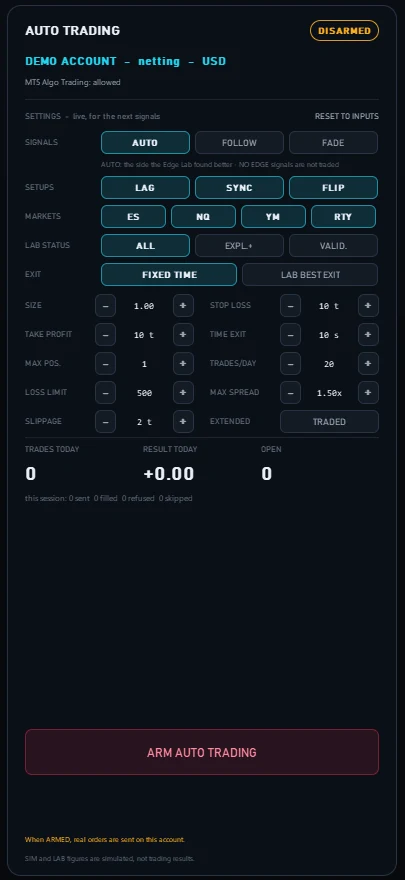
Arm it with two clicks, and every signal you selected becomes one market order in the direction to trade — with its stop loss, take profit and time exit, the scalper's way. Every decision lands in the tape.

The AUTO TRADING panel, LIVE on a demo account, disarmed: every setting changes live.
AUTO TRADING executes the signals as they are, costs included — it does not create an edge. Run it on a demo account, read the AUTO and SIM columns of the tape and the Edge Lab, and decide with numbers, not hope. Futures can lose more than you expect.
The other books moved together, a lead/lag relation into your market has been validated, and your market's book has not followed yet. NQ and RTY leading. ES lagging. Bullish flow convergence. → LONG ES.
Strong pressure aligned across the books. SYNAPSE picks the market with the best execution conditions and statistics — or your traded market.
Persistent pressure one way, then the books turn one after another — confirmed by your own book: bids building, asks thinning.
“WAIT” is not a bug. It is the most underrated word in trading — and SYNAPSE says it whenever the data do not justify a trade.

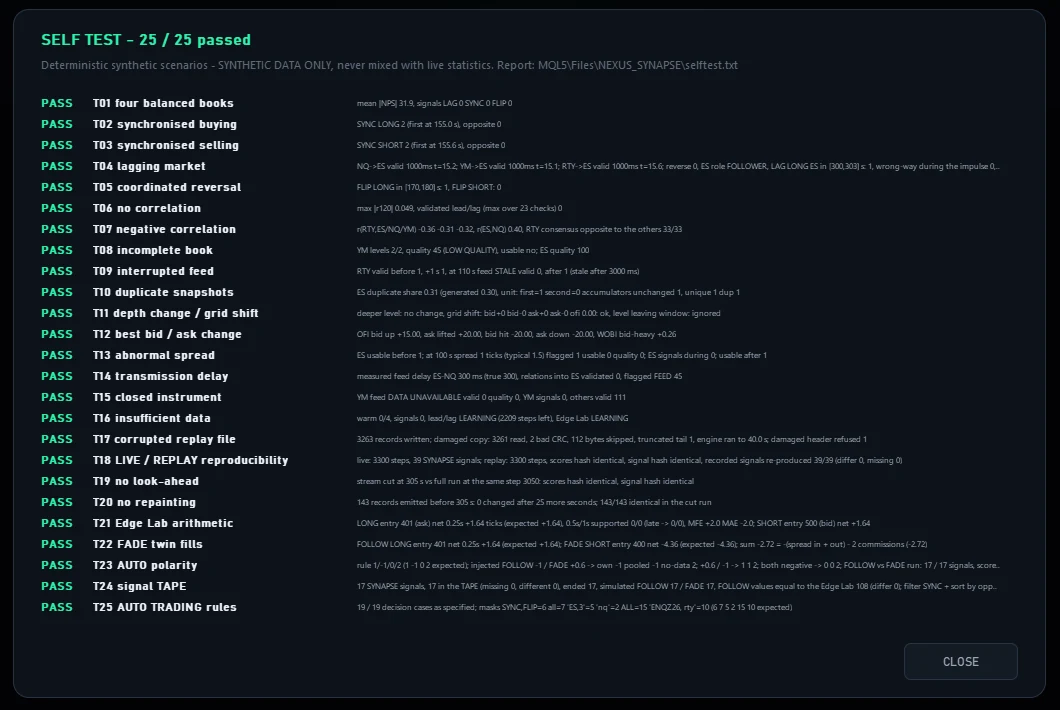
Built-in SELF TEST: 25 deterministic tests, from “no correlation” to “no repainting”, the arithmetic of every simulated fill and the rules of AUTO TRADING.
signals of two real CME sessions, US cash open included, reproduced identically in replay
per analysis step of the four books, on a consumer laptop
order-book updates per second handled on the four futures
DLL, server or subscription — and no order unless you arm AUTO TRADING

Diagnostics on the live feed: rates, duplicates, levels, spreads, quality, delays, timings.
One-time payment. No subscription. Launch prices until Monday 30 November, 23:59 (Paris time).
For clients who already own a NEXUS MATRIX licence.
For traders new to the NEXUS ecosystem.
After payment you receive the pack by email with your licence instructions. Members: add your MT5 account number to the PayPal note.
MetaTrader 5 and a broker that provides market depth (Depth of Market) for the CME index futures — typically a CQG-fed futures account. SYNAPSE was tested live on such an account with ES, NQ, YM and RTY.
Only if you want it to. The optional AUTO TRADING module sends nothing until you arm it in the cockpit (two clicks, LIVE only). Armed, it turns each selected signal into a market order with stop loss, take profit and a time exit, within your limits. Demo accounts only until you allow real accounts. Disarmed, SYNAPSE is a pure analysis tool and sends no order at all.
No. Run it on a demo account first and read the tape: every signal, its simulated result and the real result of every order. Automation executes the signals as they are, costs included; it does not turn a setup into a winner. Go live small, and only with numbers you trust.
Yes, on different contracts. On a netting account MT5 keeps one position per contract: if two robots trade the same contract, MT5 merges them and drops the stops. AUTO TRADING then closes its own lots at once and leaves the other robot's alone — but the clean way is to give each robot its own markets (AUTO TRADING has a Markets setting for exactly that).
Yes, live (new in 1.1). Besides the books (20 levels per side, every 100 ms), SYNAPSE reads the time & sales of the four futures — every trade with the side of the aggressor — and draws them as bubbles on the HEATMAP and spheres in the 3D BOOK, with the aggressive delta in the TIMELINE, NETWORK and TAPE. A wall that disappears without trades was pulled, not eaten. In REPLAY the recordings hold the books, not the trades.
AUTO in most cases: the Edge Lab picks the side per setup and market from out-of-sample results and says NO TRADE when neither side pays after costs. On the owner's own 40 hours of ES / NQ / YM / RTY (Ava, 24-26 Nov 2026), FOLLOW beat a random direction by up to about one tick at 30 s — less than the cost of a round trip with market orders — and FADE did worse. WHAT PAYS shows these numbers on your feed.
Only if your numbers say so. WHAT PAYS draws the mean result after costs for every exit from 0.25 s to 30 s, and LAB BEST EXIT lets AUTO TRADING use the exit the Lab selects on earlier results for each setup, market and side. On the owner's data 10 s was not special; 30 s was the least costly for FOLLOW.
Yes, the honest way: every signal is followed, and the Edge Lab re-tests each setup, market, side and exit walk-forward — chosen on earlier results, judged on later ones — and keeps them across sessions. The more you run it, the tighter the numbers. It does not invent an edge; it tells you whether one exists.
Yes. FADE inverts every signal. AUTO lets the Edge Lab choose, per setup and market, from out-of-sample results on your own feed — and shows NO TRADE when neither side pays. Inverting pays the spread again: the LAB shows both sides side by side before you choose.
Only when the books, the statistics and the data quality agree. On calm markets that can be rare — by design. WAIT is a valid answer.
No software can promise that, and SYNAPSE does not. It shows you what the four books are doing, tests every relation out of sample, and measures its own signals — both ways — after costs, on your feed. Most tools hide that. SYNAPSE puts it on screen.
They are simulated on observed prices (entry at the ask or bid after your latency, spread and costs included). They are not trading results and they are not a promise. Their job is to tell you honestly whether a setup works on your market — including when it does not.
Yes, on its own chart in the same terminal. NEXUS LINK can share its scores with other NEXUS programs.
Any four MT5 symbols with depth can be used. Version 1.0 is designed and documented for the four US index futures.